OECS Logo
Powered by AI
HomeCurriculumResourcesHelpSupport
  1. Home
  2. 📚Curriculum
  3. 1️⃣Grade 1
  4. 🎯Activities
  5. 🔢Mathematics
  6. Measurement-olympics

OECS Curriculum

The Organisation of Eastern Caribbean States (OECS) Curriculum Framework is designed to provide a comprehensive, student-centered approach to education across member states.

Quick Links

  • Curriculum Overview
  • Teacher Resources
  • Lesson Planner
  • About OECS
  • Privacy Policy
  • Terms of Service

Contact

OECS Commission

Morne Fortune

P.O. Box 179

Castries, Saint Lucia

Email: pearl@oecs.int

Tel: +1 758-455-6327

Subscribe to Newsletter

Stay updated with the latest curriculum resources and teaching strategies.

© 2026 Organisation of Eastern Caribbean States. All rights reserved.

    Measurement Olympics

    An exciting measurement activity where students participate in Olympic-style challenges using non-standard units to develop measurement skills and understanding.

    Activity Overview

    Measurement Olympics transforms the classroom into an exciting arena where students become measurement athletes competing in various challenges. Using non-standard units like paper clips, Unifix cubes, and string, students measure distance, capacity, and time while developing fundamental measurement concepts. This engaging approach helps young learners understand measurement as a process of comparison and develops their ability to use appropriate tools and units.
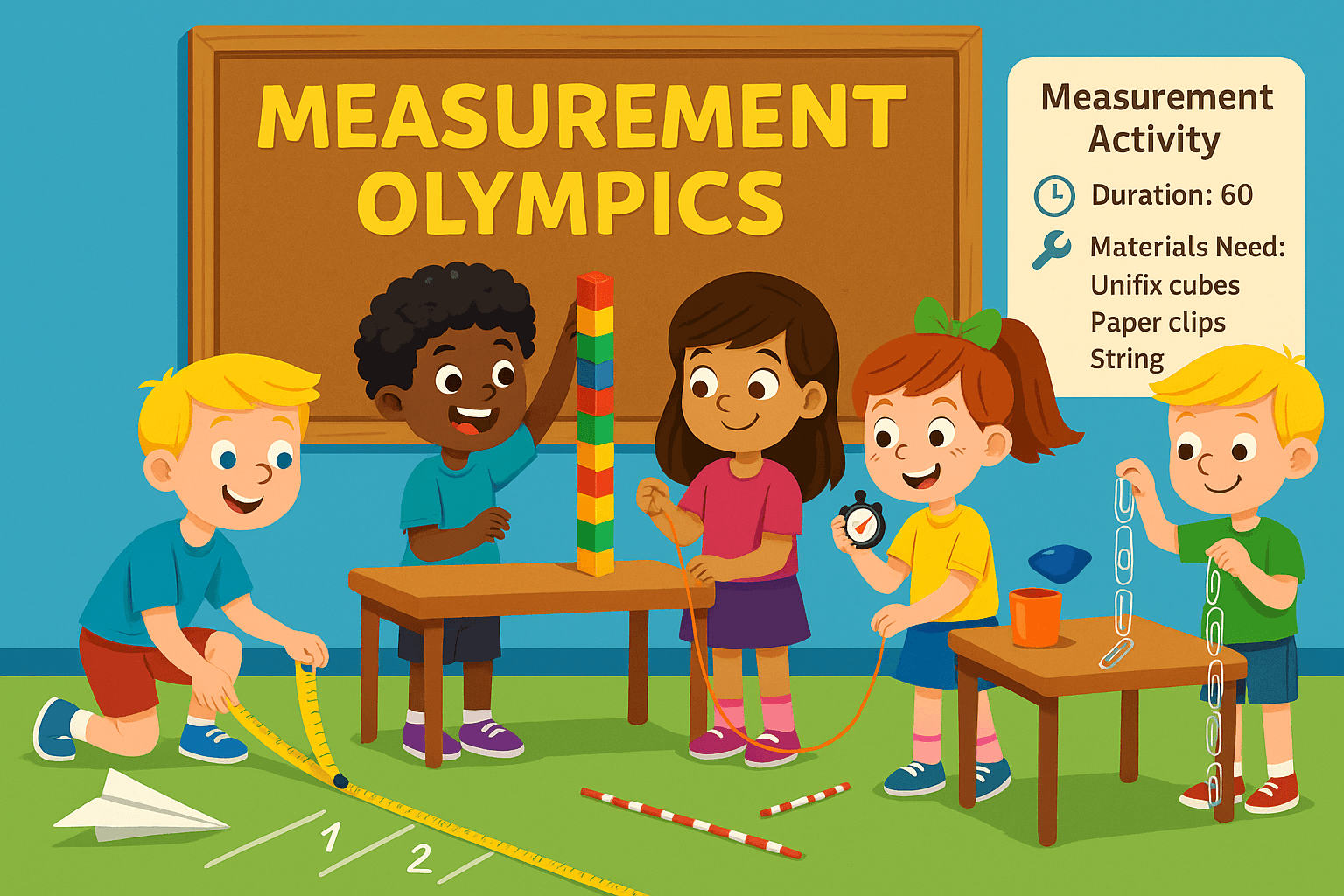
    Measurement Olympics Activity

    Learning Outcomes

    • Understand measurement as a process of comparison
    • Use non-standard units to measure length, capacity, and time
    • Develop estimation and measurement skills
    • Practice recording and comparing measurements
    • Build vocabulary related to measurement concepts
    • Work collaboratively in competitive activities
    • Connect measurement to real-world applications

    Curriculum Connections

    ELO 8: Learners will use measurement to solve problems and communicate information.

    • SCO 8.1: Use measurement concepts
    • SCO 8.2: Use measurement tools
    • SCO 8.3: Solve measurement problems

    ELO 6: Learners will use mathematical language and symbols to communicate mathematical thinking.

    • SCO 6.1: Use mathematical language
    • SCO 6.2: Use mathematical symbols
    • SCO 6.3: Communicate mathematical thinking

    Implementation Steps

    1Olympic Setup (10-15 minutes)

    • Transform classroom into Olympic arena with decorations
    • Set up measurement stations around the room
    • Introduce Olympic theme and measurement concepts
    • Explain non-standard units and their use
    • Divide students into Olympic teams

    2Distance Challenge (15-20 minutes)

    • Teams measure various distances using paper clips
    • Measure classroom objects, hallways, and play areas
    • Record measurements and compare results
    • Discuss why measurements might differ
    • Practice estimation before measuring

    3Capacity Challenge (15-20 minutes)

    • Teams measure container capacities using Unifix cubes
    • Fill various containers and count cubes needed
    • Compare container sizes and capacities
    • Estimate capacity before measuring
    • Create capacity ranking from smallest to largest

    4Time Challenge (10-15 minutes)

    • Teams complete activities while timing with sand timers
    • Measure how long different activities take
    • Compare times between teams and activities
    • Discuss why some activities take longer
    • Practice estimating time durations

    5Medal Ceremony (10-15 minutes)

    • Compile and display all measurement results
    • Award medals for different measurement categories
    • Discuss what was learned about measurement
    • Compare results and identify patterns
    • Plan future measurement challenges

    Activity Variations

    Home Olympics

    Send students home to conduct measurement challenges with family members.

    Digital Measurement

    Use tablets to photograph and record measurements for digital portfolios.

    Measurement Art

    Create artwork using measured materials and display in measurement gallery.

    Standard Units

    Introduce standard units and compare with non-standard measurements.
    Differentiation Strategies

    For Students Who Excel

    • Use more complex measurement units
    • Measure irregular shapes and objects
    • Create measurement conversion charts
    • Design new Olympic challenges

    For Students Who Need Support

    • Use larger, easier-to-count units
    • Provide measurement templates
    • Work with a partner for support
    • Focus on one measurement type at a time

    Language Considerations

    • Use measurement terms in students' home languages
    • Provide visual measurement cards for reference
    • Allow students to describe measurements in their preferred language
    • Use gestures and expressions to support understanding

    Assessment Rubric

    Measurement Accuracy

    • Excellent: Consistently accurate measurements
    • Good: Mostly accurate measurements
    • Developing: Some accurate measurements
    • Beginning: Struggles with measurement accuracy

    Unit Understanding

    • Excellent: Understands and uses units correctly
    • Good: Uses units with some understanding
    • Developing: Uses units with guidance
    • Beginning: Needs help understanding units

    Estimation Skills

    • Excellent: Makes accurate estimates
    • Good: Makes reasonable estimates
    • Developing: Makes some estimates
    • Beginning: Struggles with estimation

    Materials and Preparation Tips

    Essential Materials

    • Unifix cubes for capacity measurement
    • Paper clips for distance measurement
    • String for measuring curved surfaces
    • Cups and containers of various sizes
    • Sand timers for time measurement
    • Recording sheets for each team

    Preparation Tips

    • Set up measurement stations around the classroom
    • Prepare Olympic-themed decorations and materials
    • Test measurement activities beforehand
    • Ensure safety of all measurement areas
    • Have backup activities ready for indoor use