OECS Logo
Powered by AI
HomeCurriculumResourcesHelpSupport
  1. Home
  2. 📚Curriculum
  3. 1️⃣Grade 1
  4. 🎯Activities
  5. 🔢Mathematics
  6. Number-detectives

OECS Curriculum

The Organisation of Eastern Caribbean States (OECS) Curriculum Framework is designed to provide a comprehensive, student-centered approach to education across member states.

Quick Links

  • Curriculum Overview
  • Teacher Resources
  • Lesson Planner
  • About OECS
  • Privacy Policy
  • Terms of Service

Contact

OECS Commission

Morne Fortune

P.O. Box 179

Castries, Saint Lucia

Email: pearl@oecs.int

Tel: +1 758-455-6327

Subscribe to Newsletter

Stay updated with the latest curriculum resources and teaching strategies.

© 2026 Organisation of Eastern Caribbean States. All rights reserved.

    Number Detectives

    An engaging number sense activity where students become "number detectives" searching for numbers in their environment to develop mathematical awareness and counting skills.

    Activity Overview

    Number Detectives transforms students into mathematical investigators as they search for numbers throughout the classroom and school environment. This hands-on activity helps young learners develop number recognition, counting skills, and an understanding of how numbers are used in everyday life. Students record their findings and discuss the purpose and meaning of numbers they discover, building a strong foundation for mathematical thinking.
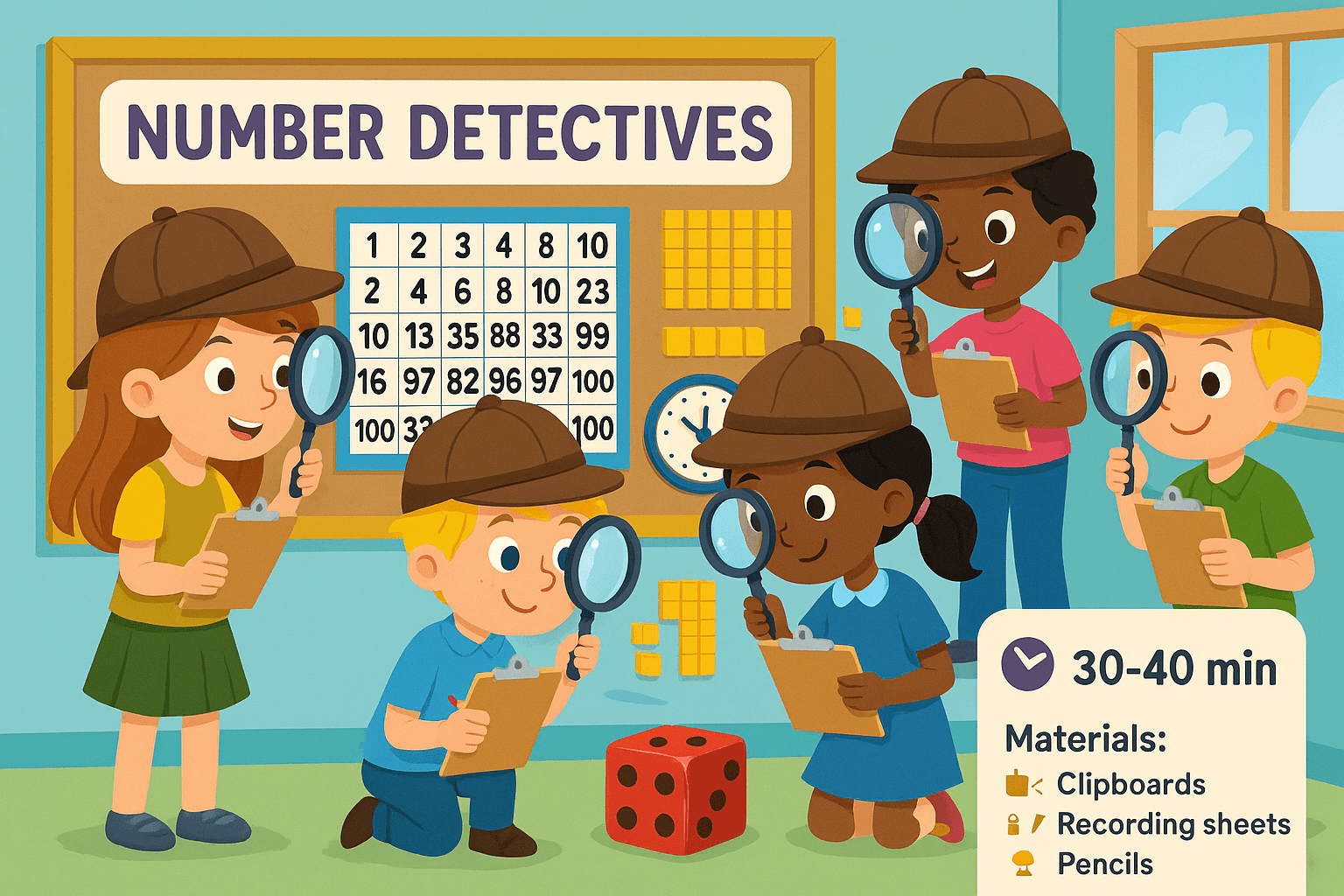
    Number Detectives Activity

    Learning Outcomes

    • Develop number recognition and counting skills
    • Understand the purpose and meaning of numbers in context
    • Practice recording and organizing mathematical information
    • Build vocabulary related to numbers and counting
    • Develop observation and investigation skills
    • Enhance communication about mathematical discoveries
    • Connect classroom learning to real-world applications

    Curriculum Connections

    ELO 4: Learners will select and use appropriate strategies and cueing systems to construct meaning when reading and viewing.

    • SCO 4.1: Use strategies and cues
    • SCO 4.2: Use phonics and structural analysis
    • SCO 4.3: Use semantic and syntactic cues

    ELO 6: Learners will use mathematical language and symbols to communicate mathematical thinking.

    • SCO 6.1: Use mathematical language
    • SCO 6.2: Use mathematical symbols
    • SCO 6.3: Communicate mathematical thinking

    Implementation Steps

    1Detective Setup (5-10 minutes)

    • Introduce the Number Detective theme with props (magnifying glasses, detective hats)
    • Explain that detectives use their eyes to find numbers everywhere
    • Set up recording sheets and clipboards for each student
    • Create a "case board" to display the day's number mystery
    • Establish safety rules for exploring the classroom

    2Number Hunt (15-20 minutes)

    • Students explore the classroom and school environment
    • Record numbers they find on their detective sheets
    • Include numbers from books, calendars, clocks, and objects
    • Take photos or draw pictures of interesting number discoveries
    • Work in pairs or small groups for support

    3Evidence Collection (10-15 minutes)

    • Return to the classroom and organize findings
    • Create a class chart of discovered numbers
    • Categorize numbers by type (counting, identification, measurement)
    • Discuss why these numbers are important
    • Share interesting discoveries with the class

    4Detective Report (10-15 minutes)

    • Students present their findings to the class
    • Use detective language: "I discovered..." "The evidence shows..."
    • Practice counting and number recognition with found numbers
    • Discuss patterns and relationships between numbers
    • Create a class number museum display

    5Case Closed (5-10 minutes)

    • Reflect on what was learned about numbers
    • Discuss where else numbers might be found
    • Plan future number detective missions
    • Celebrate successful detective work
    • Clean up materials and organize findings

    Activity Variations

    Home Detective Mission

    Send students home with detective kits to find numbers in their home environment and report back.

    Digital Number Hunt

    Use tablets to photograph numbers and create a digital number collection with captions.

    Number Story Creation

    Use discovered numbers to create simple number stories or word problems.

    Number Art Gallery

    Create artistic representations of found numbers using various art materials.

    Differentiation Strategies

    For Students Who Excel

    • Search for larger numbers (beyond 20)
    • Identify number patterns and sequences
    • Create number riddles for classmates
    • Research the history of numbers

    For Students Who Need Support

    • Focus on numbers 1-10 initially
    • Provide picture clues for number locations
    • Work with a partner for support
    • Use familiar objects and locations

    Language Considerations

    • Use numbers in students' home languages
    • Provide visual number cards for reference
    • Allow students to count in their preferred language
    • Use gestures and expressions to support understanding

    Assessment Rubric

    Number Recognition

    • Excellent: Recognizes all numbers 1-20
    • Good: Recognizes most numbers 1-20
    • Developing: Recognizes some numbers 1-10
    • Beginning: Recognizes few numbers

    Investigation Skills

    • Excellent: Finds many numbers independently
    • Good: Finds several numbers with some guidance
    • Developing: Finds some numbers with support
    • Beginning: Needs significant guidance

    Communication

    • Excellent: Clearly explains findings
    • Good: Describes most findings clearly
    • Developing: Describes some findings
    • Beginning: Struggles to communicate findings

    Materials and Preparation Tips

    Essential Materials

    • Clipboards and recording sheets for each student
    • Pencils and erasers
    • Magnifying glasses (optional but engaging)
    • Detective hats or badges for role-play
    • Chart paper for class findings

    Preparation Tips

    • Pre-scout the area for interesting number discoveries
    • Ensure safety of exploration areas
    • Prepare recording sheets with clear categories
    • Set up a central display area for findings
    • Have backup activities ready for indoor exploration