OECS Logo
Powered by AI
HomeCurriculumResourcesHelpSupport
  1. Home
  2. 📚Curriculum
  3. 1️⃣Grade 1
  4. 🎯Activities
  5. 🔢Mathematics
  6. Shape-hunt

OECS Curriculum

The Organisation of Eastern Caribbean States (OECS) Curriculum Framework is designed to provide a comprehensive, student-centered approach to education across member states.

Quick Links

  • Curriculum Overview
  • Teacher Resources
  • Lesson Planner
  • About OECS
  • Privacy Policy
  • Terms of Service

Contact

OECS Commission

Morne Fortune

P.O. Box 179

Castries, Saint Lucia

Email: pearl@oecs.int

Tel: +1 758-455-6327

Subscribe to Newsletter

Stay updated with the latest curriculum resources and teaching strategies.

© 2026 Organisation of Eastern Caribbean States. All rights reserved.

    Shape Hunt

    A geometry activity where students explore their environment to discover and identify 2D shapes, developing spatial awareness and geometric thinking skills.

    Activity Overview

    Shape Hunt is an engaging geometry activity that transforms students into shape detectives as they explore the classroom and school environment to find examples of different 2D shapes. This hands-on approach helps young learners develop spatial awareness, recognize geometric properties, and understand how shapes are used in the real world. Students create visual collages of their discoveries, building a concrete understanding of geometric concepts.
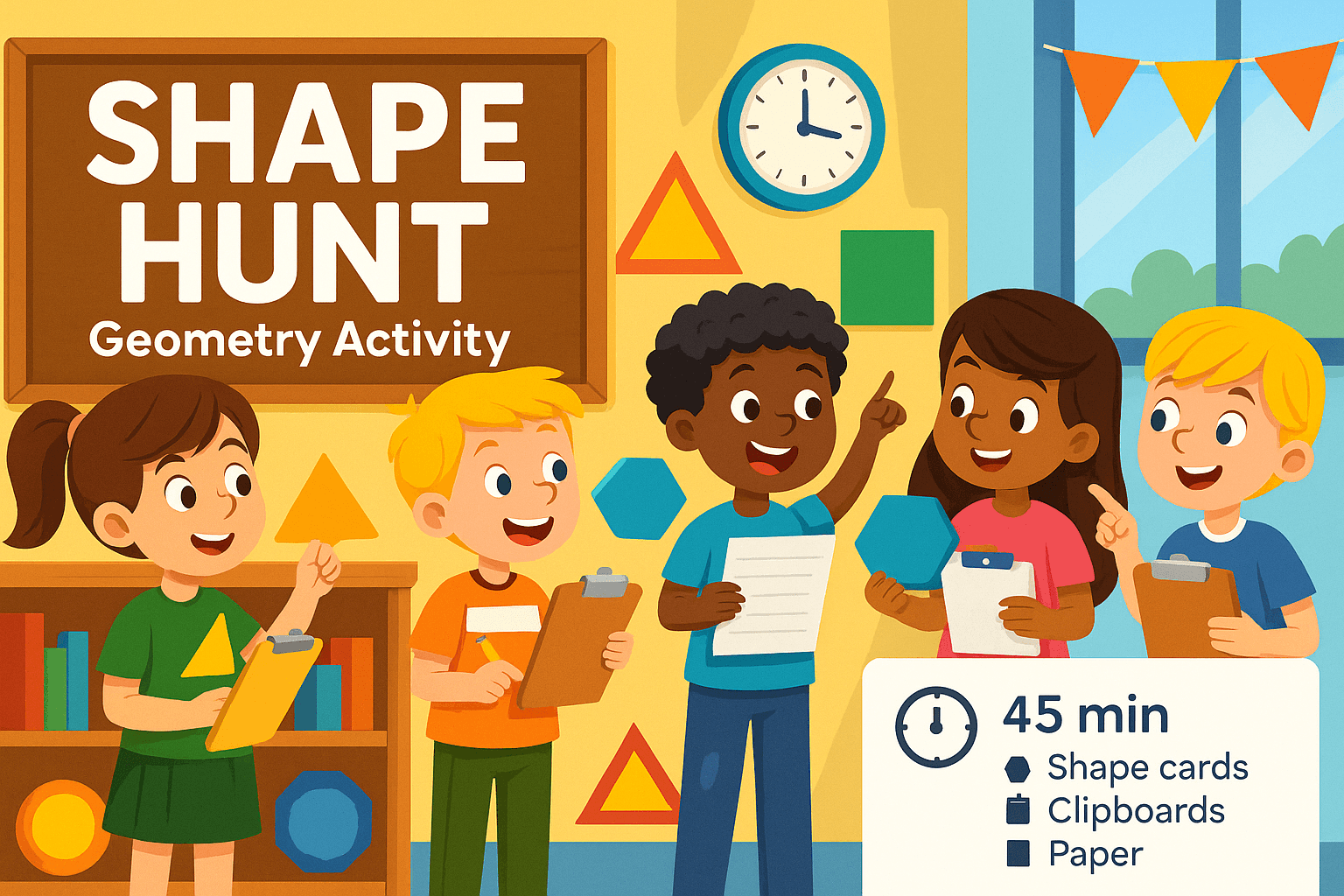
    Shape Hunt Activity

    Learning Outcomes

    • Identify and name common 2D shapes (circle, square, triangle, rectangle)
    • Recognize shapes in real-world objects and environments
    • Develop spatial awareness and geometric thinking
    • Practice observation and classification skills
    • Build geometric vocabulary and communication skills
    • Create visual representations of mathematical concepts
    • Connect classroom learning to everyday experiences

    Curriculum Connections

    ELO 6: Learners will use mathematical language and symbols to communicate mathematical thinking.

    • SCO 6.1: Use mathematical language
    • SCO 6.2: Use mathematical symbols
    • SCO 6.3: Communicate mathematical thinking

    ELO 7: Learners will use spatial relationships to solve problems.

    • SCO 7.1: Recognize and describe shapes
    • SCO 7.2: Use spatial relationships
    • SCO 7.3: Solve spatial problems

    Implementation Steps

    1Shape Introduction (5-10 minutes)

    • Review basic 2D shapes with visual examples
    • Discuss shape properties (sides, corners, curves)
    • Show shape cards and have students name them
    • Explain the shape hunting mission
    • Set up shape collection bags or folders

    2Shape Hunt (20-25 minutes)

    • Students explore the classroom and school environment
    • Look for objects that represent different shapes
    • Take photos or draw pictures of shape discoveries
    • Record findings on shape hunt worksheets
    • Work in pairs or small groups for support

    3Shape Collection (10-15 minutes)

    • Return to classroom and organize discoveries
    • Sort objects and pictures by shape type
    • Create shape categories on chart paper
    • Discuss interesting shape discoveries
    • Count how many of each shape were found

    4Shape Collage Creation (15-20 minutes)

    • Students create individual shape collages
    • Use found objects, pictures, and drawings
    • Organize by shape type or create mixed arrangements
    • Add labels and descriptions to collages
    • Share collages with classmates

    5Shape Discussion (10-15 minutes)

    • Present shape collages to the class
    • Discuss where different shapes are commonly found
    • Explore why certain shapes are used for specific purposes
    • Identify shape patterns in the environment
    • Plan future shape exploration activities

    Activity Variations

    Home Shape Hunt

    Send students home to find shapes in their home environment and create family shape collages.

    Digital Shape Collection

    Use tablets to photograph shapes and create digital shape galleries with captions.

    Shape Art Creation

    Use found shapes as inspiration for creating original artwork and designs.

    3D Shape Extension

    Extend the hunt to include 3D shapes and discuss the relationship to 2D shapes.

    Differentiation Strategies

    For Students Who Excel

    • Hunt for more complex shapes (hexagon, octagon, pentagon)
    • Identify shape properties and characteristics
    • Create shape riddles for classmates
    • Explore symmetry in found shapes

    For Students Who Need Support

    • Focus on basic shapes (circle, square, triangle)
    • Provide shape templates for tracing
    • Work with a partner for support
    • Use familiar objects and locations

    Language Considerations

    • Use shape names in students' home languages
    • Provide visual shape cards for reference
    • Allow students to describe shapes in their preferred language
    • Use gestures and expressions to support understanding

    Assessment Rubric

    Shape Recognition

    • Excellent: Identifies all basic shapes correctly
    • Good: Identifies most basic shapes correctly
    • Developing: Identifies some basic shapes
    • Beginning: Struggles with shape identification

    Shape Discovery

    • Excellent: Finds many shapes independently
    • Good: Finds several shapes with some guidance
    • Developing: Finds some shapes with support
    • Beginning: Needs significant guidance

    Shape Communication

    • Excellent: Clearly describes shape properties
    • Good: Describes most shape properties
    • Developing: Describes some shape properties
    • Beginning: Struggles to describe shapes

    Materials and Preparation Tips

    Essential Materials

    • Shape cards and reference materials
    • Clipboards and shape hunt worksheets
    • Paper, scissors, and glue for collages
    • Cameras or drawing materials for recording
    • Chart paper for organizing findings

    Preparation Tips

    • Pre-scout the area for interesting shape discoveries
    • Ensure safety of exploration areas
    • Prepare shape hunt worksheets with clear categories
    • Set up a central display area for shape collections
    • Have backup activities ready for indoor exploration