OECS Logo
Powered by AI
HomeCurriculumResourcesHelpSupport
  1. Home
  2. 📚Curriculum
  3. 1️⃣Grade 1
  4. 🎯Activities
  5. 🔢Mathematics
  6. Pattern-playground

OECS Curriculum

The Organisation of Eastern Caribbean States (OECS) Curriculum Framework is designed to provide a comprehensive, student-centered approach to education across member states.

Quick Links

  • Curriculum Overview
  • Teacher Resources
  • Lesson Planner
  • About OECS
  • Privacy Policy
  • Terms of Service

Contact

OECS Commission

Morne Fortune

P.O. Box 179

Castries, Saint Lucia

Email: pearl@oecs.int

Tel: +1 758-455-6327

Subscribe to Newsletter

Stay updated with the latest curriculum resources and teaching strategies.

© 2026 Organisation of Eastern Caribbean States. All rights reserved.

    Pattern Playground

    An engaging patterns and relationships activity where students explore, create, and extend mathematical patterns through hands-on manipulation and creative expression.

    Activity Overview

    Pattern Playground is an exciting exploration of mathematical patterns that helps students develop pattern recognition, sequencing skills, and logical thinking. Through hands-on activities with manipulatives, art materials, and movement, students discover patterns in numbers, shapes, colors, and sounds. This engaging approach builds a strong foundation for algebraic thinking and problem-solving skills while fostering creativity and mathematical joy.
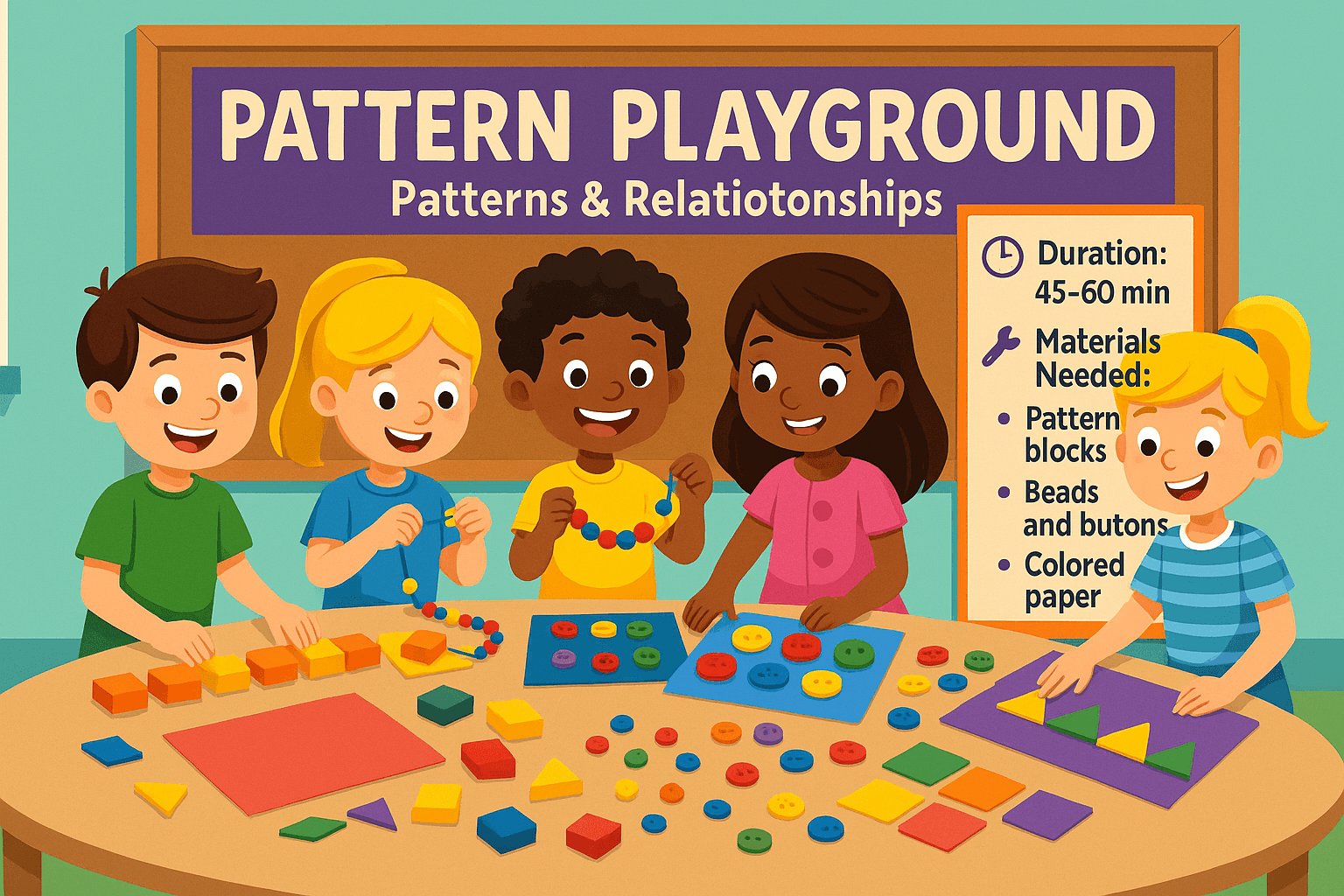
    Pattern Playground Activity

    Learning Outcomes

    • Recognize and identify simple repeating patterns
    • Create and extend patterns using various materials
    • Understand pattern rules and sequences
    • Develop logical thinking and problem-solving skills
    • Explore patterns in numbers, shapes, and colors
    • Practice pattern vocabulary and communication
    • Connect patterns to real-world applications

    Curriculum Connections

    ELO 7: Learners will use spatial relationships to solve problems.

    • SCO 7.1: Recognize and describe shapes
    • SCO 7.2: Use spatial relationships
    • SCO 7.3: Solve spatial problems

    ELO 6: Learners will use mathematical language and symbols to communicate mathematical thinking.

    • SCO 6.1: Use mathematical language
    • SCO 6.2: Use mathematical symbols
    • SCO 6.3: Communicate mathematical thinking

    Implementation Steps

    1Pattern Introduction (10-15 minutes)

    • Introduce the concept of patterns in everyday life
    • Show examples of simple repeating patterns
    • Demonstrate pattern vocabulary: repeat, extend, rule
    • Explore patterns in clothing, nature, and classroom
    • Set up pattern exploration stations

    2Pattern Exploration (15-20 minutes)

    • Students explore pattern materials at different stations
    • Use manipulatives to create simple patterns
    • Practice identifying pattern rules and sequences
    • Work with partners to extend each other's patterns
    • Record pattern discoveries in pattern journals

    3Pattern Creation (15-20 minutes)

    • Students design their own unique patterns
    • Use various materials: beads, blocks, paper, colors
    • Create patterns with different rules and sequences
    • Practice extending patterns in multiple directions
    • Share pattern creations with classmates

    4Pattern Games (15-20 minutes)

    • Play "What Comes Next?" pattern guessing games
    • Create pattern chains around the classroom
    • Practice pattern movement and dance activities
    • Solve pattern puzzles and challenges
    • Celebrate creative pattern solutions

    5Pattern Gallery (10-15 minutes)

    • Display all pattern creations in a classroom gallery
    • Students present their patterns to the class
    • Discuss pattern rules and mathematical thinking
    • Identify patterns in the gallery display
    • Plan future pattern exploration activities

    Activity Variations

    Nature Patterns

    Explore patterns found in nature: leaves, flowers, shells, and animal markings.

    Sound Patterns

    Create and identify patterns using rhythm, clapping, and musical instruments.

    Movement Patterns

    Create physical movement patterns using dance, exercise, and body movements.

    Digital Patterns

    Use tablets and computers to create and explore digital patterns.

    Differentiation Strategies

    For Students Who Excel

    • Create complex patterns with multiple rules
    • Explore growing patterns and sequences
    • Design pattern challenges for classmates
    • Investigate mathematical pattern relationships

    For Students Who Need Support

    • Start with simple two-element patterns
    • Use larger, easier-to-handle materials
    • Provide pattern templates and guides
    • Work with a partner for support

    Language Considerations

    • Use pattern vocabulary in students' home languages
    • Provide visual pattern cards for reference
    • Allow students to describe patterns in their preferred language
    • Use gestures and expressions to support understanding

    Assessment Rubric

    Pattern Recognition

    • Excellent: Recognizes complex patterns independently
    • Good: Recognizes most simple patterns
    • Developing: Recognizes some simple patterns
    • Beginning: Struggles with pattern recognition

    Pattern Creation

    • Excellent: Creates complex, original patterns
    • Good: Creates simple patterns with guidance
    • Developing: Creates basic patterns with support
    • Beginning: Needs help creating patterns

    Pattern Extension

    • Excellent: Extends patterns in multiple directions
    • Good: Extends patterns in one direction
    • Developing: Extends patterns with support
    • Beginning: Struggles to extend patterns

    Materials and Preparation Tips

    Essential Materials

    • Pattern blocks and geometric shapes
    • Beads, buttons, and small objects
    • Colored paper and art supplies
    • Pattern cards and templates
    • Recording sheets for pattern journals

    Preparation Tips

    • Set up pattern exploration stations around the classroom
    • Prepare pattern examples and templates
    • Organize materials in easy-to-access containers
    • Have backup activities ready for different skill levels
    • Test pattern activities beforehand