OECS Logo
Powered by AI
HomeCurriculumResourcesHelpSupport
  1. Home
  2. 📚Curriculum
  3. 1️⃣Grade 1
  4. 🎯Activities
  5. 🔢Mathematics
  6. Ten-frame-fun

OECS Curriculum

The Organisation of Eastern Caribbean States (OECS) Curriculum Framework is designed to provide a comprehensive, student-centered approach to education across member states.

Quick Links

  • Curriculum Overview
  • Teacher Resources
  • Lesson Planner
  • About OECS
  • Privacy Policy
  • Terms of Service

Contact

OECS Commission

Morne Fortune

P.O. Box 179

Castries, Saint Lucia

Email: pearl@oecs.int

Tel: +1 758-455-6327

Subscribe to Newsletter

Stay updated with the latest curriculum resources and teaching strategies.

© 2026 Organisation of Eastern Caribbean States. All rights reserved.

    Ten Frame Fun

    An engaging number sense activity using ten frames to develop counting, addition, and number composition skills through hands-on exploration and games.

    Activity Overview

    Ten Frame Fun is an interactive number sense activity that uses ten frames to help students develop a deep understanding of numbers 1-10 and beyond. Through hands-on manipulation of counters, dice, and ten frame mats, students explore number composition, addition strategies, and visual representations of quantities. This engaging approach builds a strong foundation for mathematical thinking and problem-solving skills.
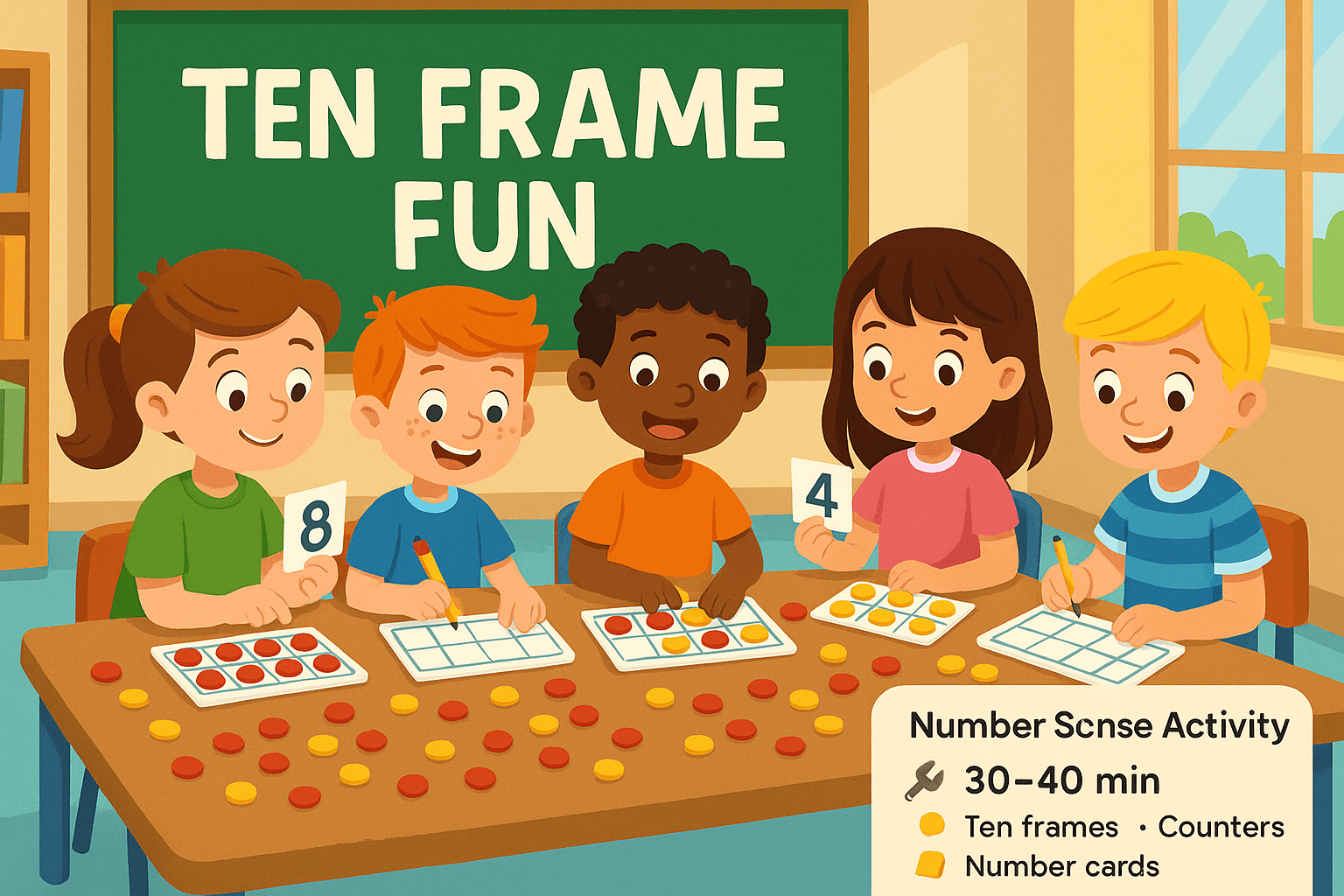
    Ten Frame Fun Activity

    Learning Outcomes

    • Recognize and represent numbers 1-10 on ten frames
    • Understand number composition and decomposition
    • Develop addition strategies using visual models
    • Practice counting and subitizing skills
    • Build number sense and mathematical fluency
    • Work with partners in cooperative learning activities
    • Connect concrete manipulatives to abstract concepts

    Curriculum Connections

    ELO 5: Learners will use number concepts and operations to solve problems.

    • SCO 5.1: Use number concepts
    • SCO 5.2: Use number operations
    • SCO 5.3: Solve number problems

    ELO 6: Learners will use mathematical language and symbols to communicate mathematical thinking.

    • SCO 6.1: Use mathematical language
    • SCO 6.2: Use mathematical symbols
    • SCO 6.3: Communicate mathematical thinking

    Implementation Steps

    1Ten Frame Introduction (10-15 minutes)

    • Introduce ten frames as a tool for showing numbers
    • Demonstrate filling a ten frame with counters
    • Practice counting numbers 1-10 on ten frames
    • Discuss the visual patterns created
    • Introduce vocabulary: full, empty, row, column

    2Number Recognition Games (15-20 minutes)

    • Play "Show Me" with ten frame cards
    • Students create numbers on their ten frames
    • Practice subitizing (quick recognition) of quantities
    • Compare different representations of the same number
    • Work in pairs to check each other's work

    3Addition Activities (15-20 minutes)

    • Roll dice and add numbers using ten frames
    • Explore different ways to make the same sum
    • Practice "making ten" strategies
    • Record addition sentences with ten frame drawings
    • Discuss efficient counting strategies

    4Partner Games (15-20 minutes)

    • Play "Ten Frame War" with number cards
    • Create number stories using ten frames
    • Challenge partners to find missing addends
    • Practice verbalizing mathematical thinking
    • Celebrate successful problem-solving strategies

    5Reflection and Extension (10-15 minutes)

    • Share favorite ten frame activities
    • Discuss what was learned about numbers
    • Explore how ten frames help with counting
    • Plan future ten frame challenges
    • Create individual ten frame portfolios

    Activity Variations

    Double Ten Frames

    Extend to numbers 11-20 using two ten frames side by side.

    Digital Ten Frames

    Use interactive whiteboards or tablets for digital ten frame activities.

    Ten Frame Stories

    Create word problems and stories using ten frame representations.

    Ten Frame Art

    Create artistic representations using ten frame patterns and designs.

    Differentiation Strategies

    For Students Who Excel

    • Work with larger numbers (11-20)
    • Explore subtraction using ten frames
    • Create complex addition combinations
    • Design new ten frame games

    For Students Who Need Support

    • Focus on numbers 1-5 initially
    • Use larger, easier-to-handle counters
    • Provide ten frame templates with outlines
    • Work with a partner for support

    Language Considerations

    • Use number words in students' home languages
    • Provide visual number cards for reference
    • Allow students to count in their preferred language
    • Use gestures and expressions to support understanding

    Assessment Rubric

    Number Recognition

    • Excellent: Recognizes all numbers 1-10 on ten frames
    • Good: Recognizes most numbers 1-10 on ten frames
    • Developing: Recognizes some numbers 1-10 on ten frames
    • Beginning: Struggles with number recognition

    Ten Frame Usage

    • Excellent: Uses ten frames independently and accurately
    • Good: Uses ten frames with some guidance
    • Developing: Uses ten frames with significant support
    • Beginning: Needs help using ten frames

    Addition Skills

    • Excellent: Solves addition problems using ten frames
    • Good: Solves some addition problems using ten frames
    • Developing: Solves addition problems with support
    • Beginning: Struggles with addition concepts

    Materials and Preparation Tips

    Essential Materials

    • Ten frame mats (laminated or printed)
    • Counters (Unifix cubes, buttons, or small objects)
    • Dice for number generation
    • Number cards (1-10)
    • Recording sheets for activities

    Preparation Tips

    • Prepare enough ten frame mats for each student
    • Organize counters in easy-to-access containers
    • Set up partner work stations around the classroom
    • Have backup activities ready for different skill levels
    • Test ten frame activities beforehand