OECS Logo
Powered by AI
HomeCurriculumCommunitiesResourcesHelp
  1. Home
  2. 📚Curriculum
  3. 1️⃣Grade 1
  4. 🎯Activities
  5. 🔬Science
  6. Push-pull-playground

OECS Curriculum

The Organisation of Eastern Caribbean States (OECS) Curriculum Framework is designed to provide a comprehensive, student-centered approach to education across member states.

Quick Links

  • Curriculum Overview
  • Teacher Resources
  • Lesson Planner
  • About OECS
  • Privacy Policy
  • Terms of Service

Contact

OECS Commission

Morne Fortune

P.O. Box 179

Castries, Saint Lucia

Email: pearl@oecs.int

Tel: +1 758-455-6327

Subscribe to Newsletter

Stay updated with the latest curriculum resources and teaching strategies.

© 2026 Organisation of Eastern Caribbean States. All rights reserved.

    Push and Pull Playground

    A hands-on physical science exploration where students investigate forces by experimenting with how objects move when pushed or pulled in different ways.

    Activity Overview

    Push and Pull Playground engages students in exploring the fundamental concept of forces through hands-on experimentation with everyday objects. Students investigate how different strengths and directions of pushes and pulls affect object movement, explore how surface materials change motion, and discover that forces are all around us in daily life. This playful yet scientific approach builds foundational understanding of physics concepts while developing observation and prediction skills.
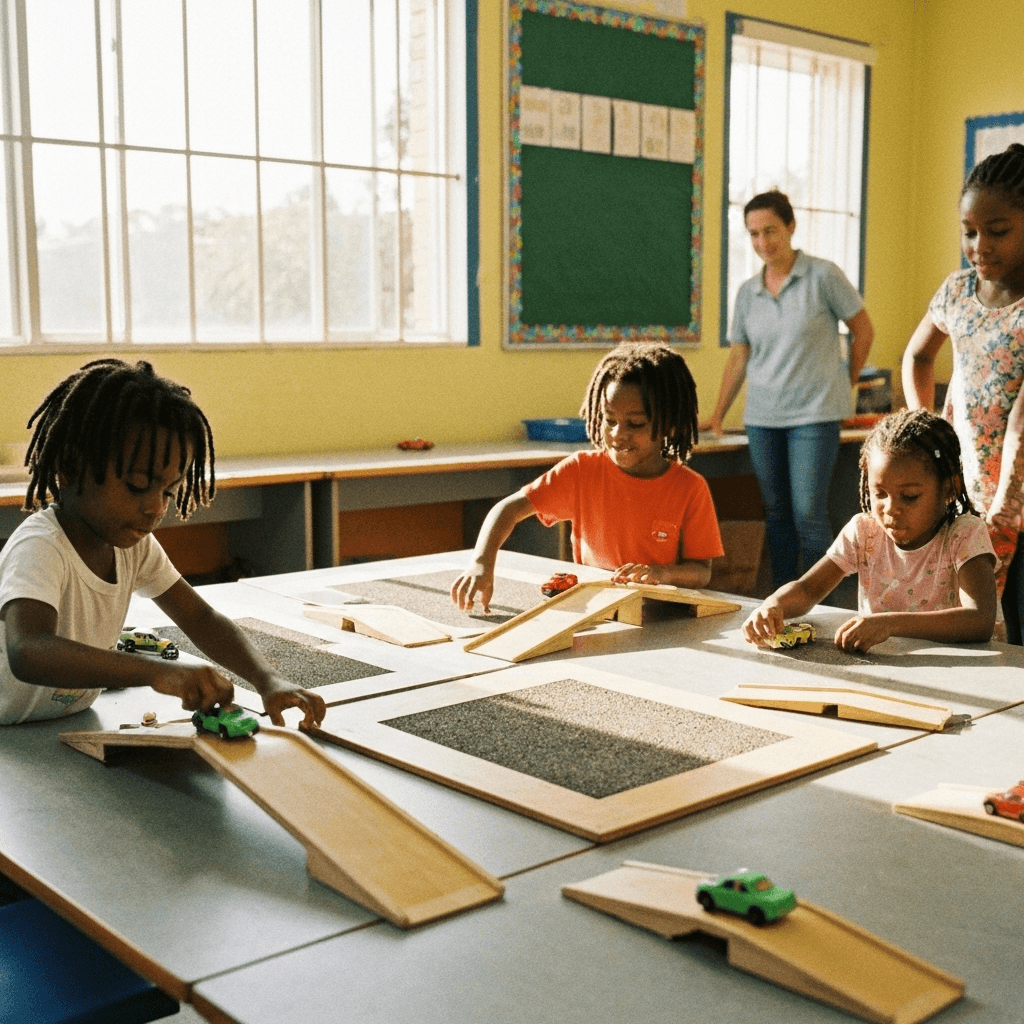
    Push and Pull Playground Activity

    Learning Outcomes

    • Understand that pushes and pulls are forces that make objects move
    • Investigate how the strength of a force affects object movement
    • Explore how different surfaces affect how objects move
    • Predict and test how objects will move when forces are applied
    • Recognize forces in everyday activities and play
    • Develop vocabulary related to forces and motion
    • Practice scientific observation and recording skills

    Curriculum Connections

    Physical Science: Forces and motion

    • Understanding pushes and pulls as forces
    • How forces affect object movement
    • Factors that influence motion

    Scientific Inquiry: Experimentation and prediction

    • Making predictions about object movement
    • Testing ideas through hands-on experimentation
    • Observing and recording results

    Implementation Steps

    1Introduction and Force Discovery (15 minutes)

    • Begin by asking students to show different ways to move objects
    • Demonstrate pushing and pulling with classroom objects
    • Introduce vocabulary: push, pull, force, move, stop
    • Have students identify pushes and pulls in their daily activities
    • Discuss: "What happens when you push or pull something?"

    2Toy Car Investigations (20 minutes)

    • Provide toy cars and flat surfaces for each group
    • Students experiment with gentle and strong pushes
    • Observe: "What happens with a gentle push vs. a strong push?"
    • Try pulling cars with string - compare to pushing
    • Record observations: How far did the car travel?
    • Discuss findings about force strength and distance

    3Surface Testing Experiments (20 minutes)

    • Set up stations with different surface materials
    • Test how cars move on carpet, wood, sandpaper, and smooth surfaces
    • Students predict: "Which surface will the car travel farthest on?"
    • Test predictions using the same push strength
    • Compare results and discuss why surfaces make a difference
    • Introduce concept of friction in simple terms

    4Ramp and Ball Exploration (15 minutes)

    • Set up ramps at different angles
    • Roll balls of different sizes down the ramps
    • Observe how ramp steepness affects ball speed
    • Try different ball sizes and weights
    • Discuss: "What force makes the ball roll down?"
    • Connect to playground slides and rolling objects

    5Force Hunt and Reflection (10 minutes)

    • Students look around the classroom for examples of pushes and pulls
    • Share findings: doors, drawers, books, pencils
    • Act out different forces they use during the school day
    • Record favorite discoveries in science journals
    • Discuss how forces help us in daily life
    • Plan to notice forces at home and report back

    Activity Variations

    Force Olympics

    Create stations where students compete in force challenges: farthest push, strongest pull, most accurate aim.

    Magnetic Forces

    Explore magnetic pushes and pulls using magnets and various objects to test magnetic attraction and repulsion.

    Force Art

    Create art using forces - paint by rolling balls through paint, or make prints by pushing objects into clay.

    Playground Forces

    Take the investigation outside to explore forces on playground equipment: swings, slides, seesaws.

    Differentiation Strategies

    For Advanced Learners

    • Measure distances traveled and create simple graphs
    • Explore how object weight affects force needed to move it
    • Investigate forces in simple machines like levers and pulleys
    • Design experiments to test specific force questions

    For Students Needing Support

    • Focus on basic push vs. pull identification
    • Use larger, easier-to-handle objects
    • Provide guided questions for observations
    • Work with a partner for support and collaboration
    • Use picture cards to show force concepts

    Language Support

    • Provide force vocabulary cards with pictures and actions
    • Use gestures and demonstrations for force words
    • Allow drawing to show understanding of forces
    • Connect to force words in students' home languages
    • Use simple sentence frames for describing observations

    Assessment Rubric

    Force Understanding

    • Excellent: Explains how pushes and pulls make objects move
    • Good: Identifies pushes and pulls in various situations
    • Developing: Recognizes basic force actions with support
    • Beginning: Needs significant guidance

    Prediction and Testing

    • Excellent: Makes logical predictions and tests systematically
    • Good: Makes some predictions and tests with guidance
    • Developing: Makes basic predictions with support
    • Beginning: Needs help making and testing predictions

    Scientific Vocabulary

    • Excellent: Uses force vocabulary correctly and confidently
    • Good: Uses some force terms appropriately
    • Developing: Uses basic vocabulary with prompts
    • Beginning: Limited use of scientific terms

    Materials and Safety

    Essential Materials

    • Toy cars (various sizes)
    • Balls of different sizes and weights
    • Ramps (books, boards, or commercial ramps)
    • Surface materials: carpet, wood, sandpaper, smooth plastic
    • String for pulling experiments
    • Recording sheets and pencils
    • Optional: spring scales for measuring force

    Safety and Setup

    • Ensure clear pathways for moving objects
    • Supervise ramp activities to prevent falls
    • Use soft balls to prevent injury
    • Create boundaries for each group's workspace
    • Have students sit while testing to avoid collisions
    • Check that all materials are in good condition